
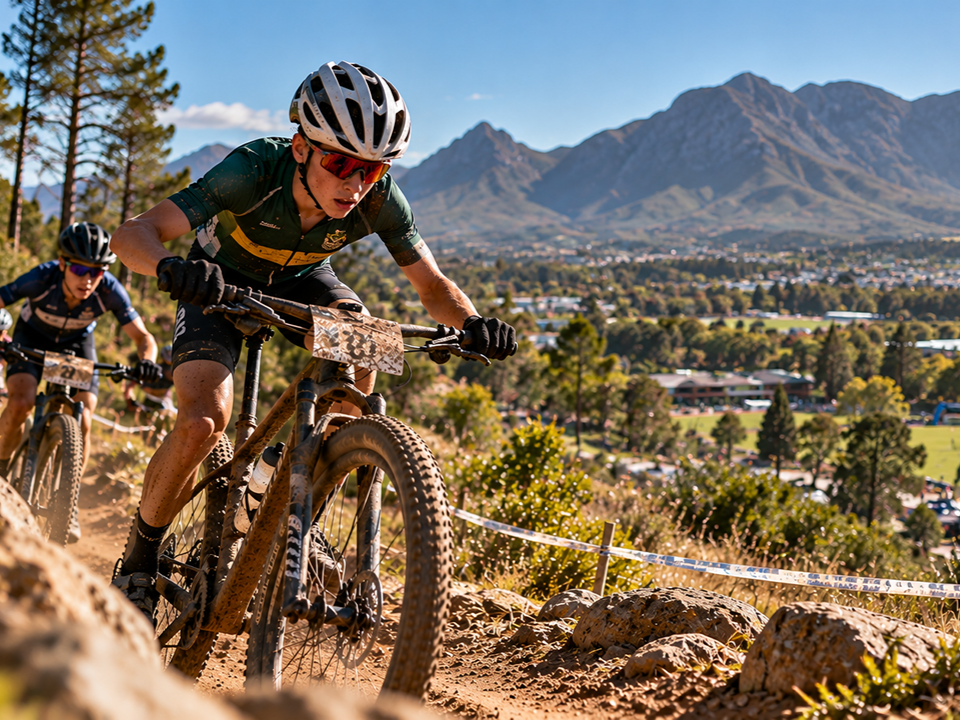
National-level youth mountain-bike racing is more than a test of who can produce the most power. At the 2026 National Schools MTB Finals in Stellenbosch, young riders from across South Africa—and riders from Namibia—were competing in a national environment where physical preparation, technical skill, pacing, race craft and recovery all matter.
The primary-school finals were held on 28–29 September, followed by the high-school finals on 2–3 October. The results provide a useful reminder that youth MTB is already a serious performance pathway, not simply a participation category.
The race is more than fitness
A young rider can be physically strong and still lose time through poor line choice, inconsistent pacing or technical mistakes.
MTB racing repeatedly changes the demands placed on the athlete. Climbs require sustained power. Descents require control and decision-making. Tight corners reward braking and positioning. Short changes in gradient can demand repeated accelerations rather than one continuous effort.
That means preparation cannot be built around fitness alone.
The objective is to develop the physical capacity to produce the required effort while also allowing the athlete to use that capacity effectively on the course.
Technical skill becomes part of performance
Technical riding is sometimes treated as something separate from conditioning. In racing, the two interact.
As fatigue accumulates, concentration and decision-making can change. A rider who handles a technical section confidently when fresh may become less precise late in a race. The answer is not to make every training session deliberately exhausting. It is to recognise where competition requires technical execution under physical load and progressively prepare for that combination.
For developing riders, this also means that technical skill should not be sacrificed simply to add more training volume.
Pacing matters even in short races
Youth racing can be fast from the start, which makes pacing particularly important.
Starting above a sustainable effort can create unnecessary fatigue before the decisive parts of the course. Conversely, riding too conservatively can leave an athlete unable to respond when the race accelerates.
Good pacing is therefore about understanding the course and the athlete’s own capabilities. Where are the likely decisive sections? Which climbs can be ridden hard? Where is it worth protecting energy? Where can technical efficiency save time without requiring additional physical output?
These are coaching questions, not simply fitness questions.
Recovery is part of development
A national championship can be a major experience for a young athlete, but the event should be viewed within the wider development process.
Training load, school commitments, travel, sleep and nutrition all influence how well a young rider can absorb training and perform. More training is not automatically better if the athlete cannot recover from it.
The same principle applies during competition. When racing takes place over consecutive days, the ability to restore energy, rehydrate, sleep and arrive at the next start mentally ready becomes part of performance.
The South African pathway matters
The National Schools Finals also show the depth of the youth MTB environment. The results included riders from schools across the country, while Namibian riders also competed successfully in the field. The high-school Youth 15 results, for example, show a tightly contested front group separated by less than two minutes across the leading positions.
That competitive environment is useful for identifying what developing athletes need next.
The goal should not be to copy the training of senior elite riders. Youth athletes are still developing physically and technically, and their training needs to be appropriate to their age, experience, school demands and long-term objectives.
The MCC coaching perspective
The important lesson from national-level youth MTB is not that young riders need to train harder.
It is that performance is multidimensional.
A developing rider needs appropriate physical conditioning, technical competence, pacing awareness, race experience and enough recovery to adapt. The coach’s role is to bring those elements together without losing sight of the athlete’s long-term development.
Athlete takeaway: youth MTB performance is not built by chasing one number. Build the rider’s ability to produce power, manage effort, ride technically under pressure and recover consistently.
Source:
RaceFace, 2026 SCSA National Schools Final results — https://www.raceface.co.za/results/; BoutTime, 2026 Cycle Lab MTB National Schools Final results — https://www.bouttime.co.za/Results/ResultCycleLab.aspx?EventId=1600. National schools event reporting reviewed as factual context; technical, pacing, development and coaching implications are MCC interpretation.