
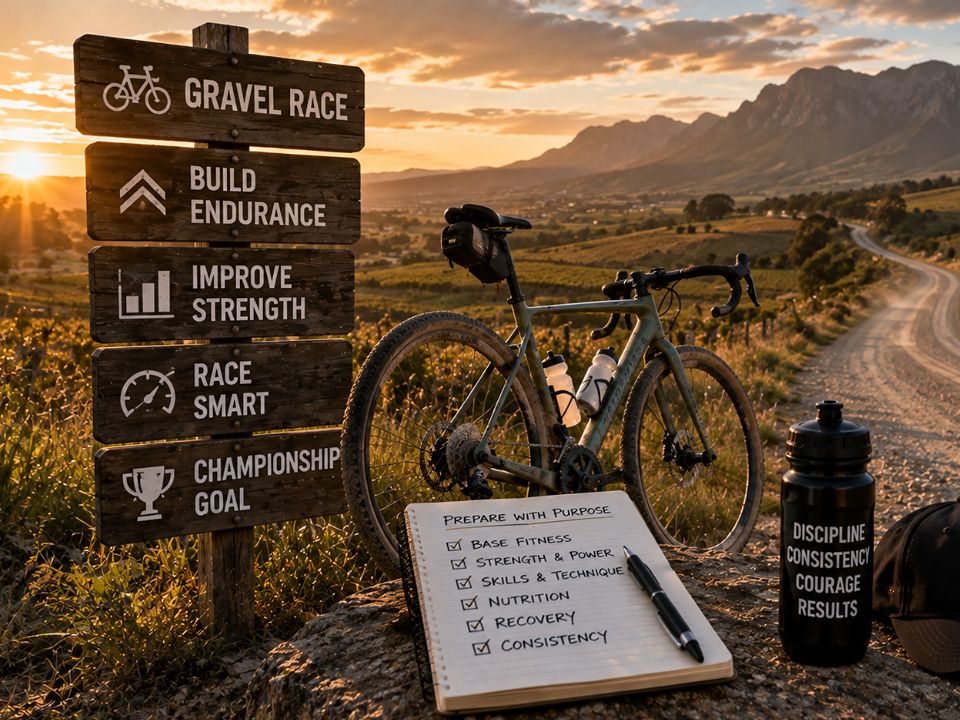
South African gravel racing is developing into a more structured part of the endurance landscape, with riders able to approach events with very different ambitions.
For one rider, the objective may simply be to finish. Another may want to qualify for a championship opportunity. A third may be targeting an overall performance.
Those are not the same goal, and they should not produce the same training plan.
Define the objective first
“Getting ready for a gravel race” is too broad to guide good coaching.
A rider preparing simply to complete an event may need a different balance of endurance, technical skills, pacing and recovery from a rider targeting a competitive result. A qualification goal adds another layer: the athlete needs to understand the performance standard required and build preparation around it.
The first coaching decision is therefore not which interval session to do. It is defining what success actually means.
The demands change with the goal
Participation requires enough durability to handle the distance and terrain.
Qualification requires a more specific level of performance. That may mean greater attention to sustainable power, pacing, repeatability, technical efficiency and the ability to perform when fatigue accumulates.
Performance at the sharp end adds further demands. Equipment choices, positioning, technical confidence, fuelling execution and race tactics become increasingly important.
The important point is that these elements should be developed in proportion to the actual objective.
Don’t copy the elite rider
Elite gravel racing can provide useful examples, but an elite result is not a prescription for an age-group athlete.
The athlete’s training history, available training time, equipment, technical ability, recovery capacity and racing experience all influence what is realistic.
A qualification pathway should therefore be treated as a performance problem to solve, not simply as another reason to increase training volume.
Train the specific demands
Once the objective is clear, training can become more specific.
A rider targeting a strong gravel performance should progressively expose themselves to the combination of sustained effort, changes in pace, terrain and technical demands likely to occur during competition. Fuelling and hydration should also be practised rather than left to race day.
The closer the athlete gets to the event, the more useful race-specific sessions become—but specificity should be built on an appropriate base.
The MCC coaching perspective
The difference between participation, qualification and performance is not just semantics. It changes the entire preparation strategy.
Start with the outcome. Identify what the athlete must be able to do to achieve it. Then build the physical, technical and tactical preparation required.
Athlete takeaway: before asking how hard you need to train for a gravel event, decide what you are actually trying to achieve. The goal determines the preparation.
Source:
MCC original coaching/editorial article. The article presents an MCC coaching framework for distinguishing participation, qualification and performance goals;