
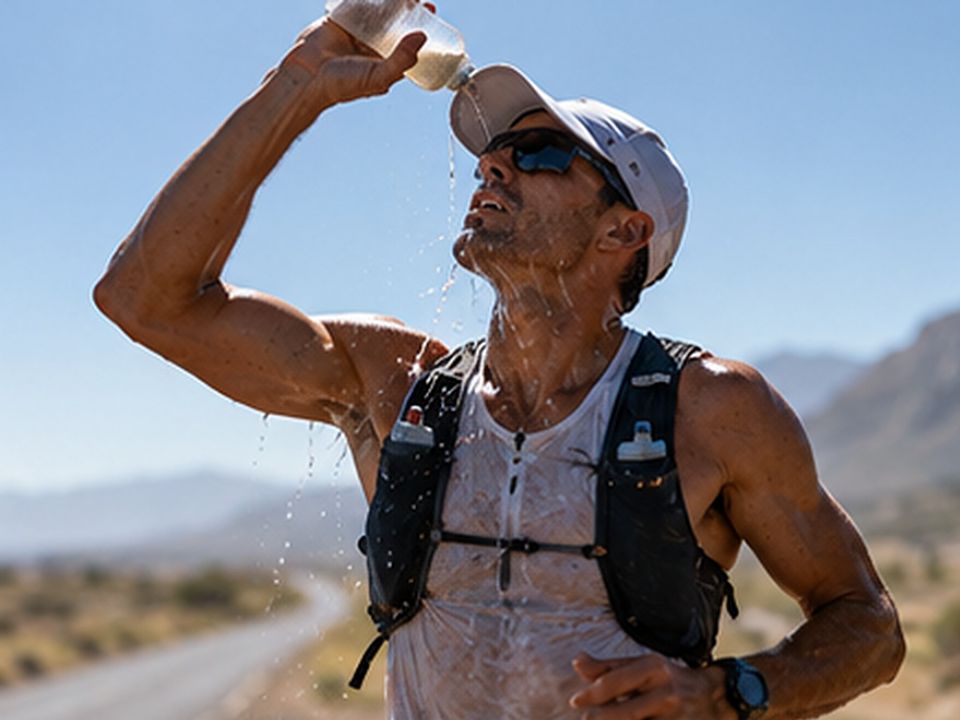
Heat is not simply a hydration problem. For endurance athletes racing in hot or humid conditions, the aim is to manage the total thermal load the body is facing while still maintaining enough fluid and fuel to perform.
A new real-world analysis of 312 endurance athletes across four hot-humid mass-participation events examined a graded cooling and fluid-replacement strategy. The researchers found that the strategy was associated with lower post-race core temperature and better physiological, medical and performance outcomes. The important qualification is that this was an observational analysis rather than a randomised trial, so it supports the approach but does not prove that the intervention caused the outcomes.
For athletes, the useful message is therefore not “drink more”. It is to think about heat management as a system.
Start before race day
Heat preparation begins before the event. If an athlete knows a race is likely to be hot or humid, training should include appropriate exposure to the environmental demands where possible. The objective is not simply to suffer through heat, but to understand how the individual responds and to practise the strategies that will be used on race day.
That includes learning how much fluid the athlete can comfortably consume, identifying practical cooling opportunities and understanding how heat affects pace, power, heart rate and perceived effort.
Cooling is part of the strategy
Cooling can take different forms depending on the event. Pre-cooling, access to cold fluids, ice, water applied to the skin or other practical cooling opportunities may all have a place. The right approach depends on the event, conditions, access to resources and the athlete.
This is particularly relevant in long South African summer races, where the environmental load can become a performance limiter even when the athlete is otherwise well prepared.
Fluid replacement still matters — but individually
Fluid strategy should be based on the athlete and the conditions rather than a universal target. Sweat rate, body size, exercise duration, temperature, humidity and access to fluids all matter.
More fluid is not automatically better. The objective is to manage fluid losses without creating a new problem through excessive drinking or a strategy that the athlete has not practised.
The coaching takeaway
The strongest practical lesson from the new evidence is that cooling and fluid replacement should not be treated as separate race-day topics. They form part of the same environmental preparation strategy.
For an MCC athlete, the useful process is simple: understand the expected conditions, practise the response in training, individualise fluid intake, identify realistic cooling opportunities and adjust pacing expectations when the environment changes the demand.
The study provides supportive evidence for this integrated approach, but it should not be presented as definitive proof of causation. Good heat management remains an individual coaching problem — and the best strategy is the one an athlete has tested before race day.
Source:
Li H, Cao X, Feng S. “Mitigating exertional heat illness risk and preserving performance in mass-participation endurance events: a real-world analysis of a graded cooling and fluid replacement strategy.” Journal of Science and Medicine in Sport. 2026. https://pubmed.ncbi.nlm.nih.gov/42786052/ — observational analysis of 312 endurance athletes across four hot-humid events; use as supportive evidence, not proof of causation.