
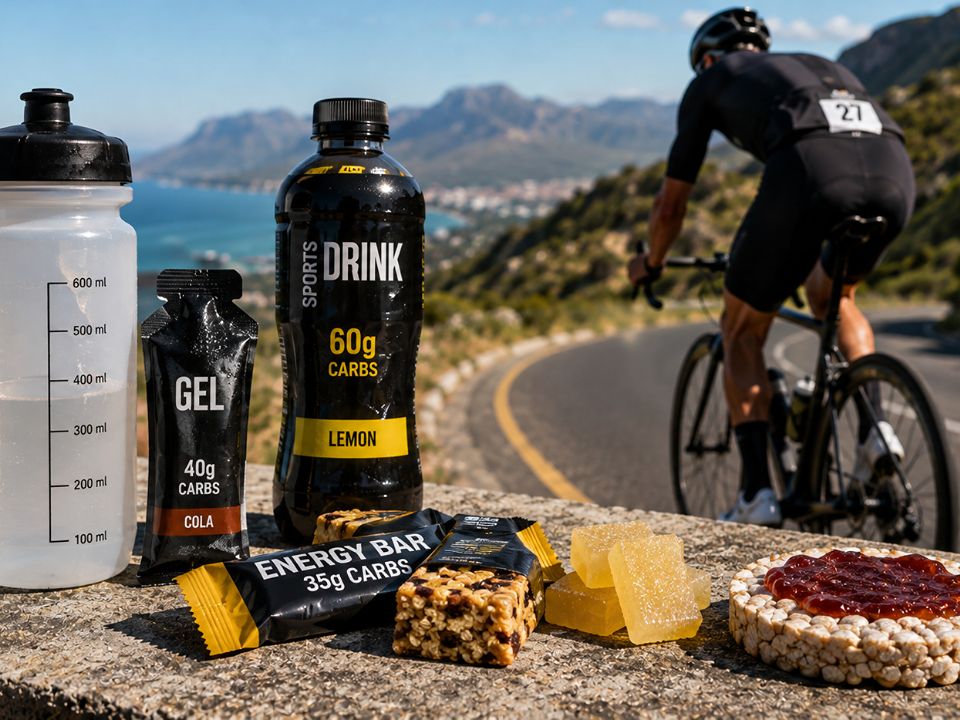
The simple answer is: probably not the same amount as everyone else.
Carbohydrate has become one of the most discussed performance tools in endurance sport. But the latest evidence gives athletes a reason to be careful about turning a headline number into a universal rule.
THE NUMBER ISN’T THE WHOLE STRATEGY
Higher carbohydrate intake can be useful during prolonged endurance exercise, particularly when athletes are working hard for long periods. But a grams-per-hour target only describes one part of the problem. The athlete still has to absorb it, tolerate it and use it effectively.
Recent research examining carbohydrate supplementation during endurance exercise in the heat has found mixed effects on performance and no consistent evidence that carbohydrate automatically improves hydration or thermoregulation. The research also highlights gaps in how gastrointestinal symptoms are reported.
SO HOW HIGH SHOULD YOU GO?
Recent research and reviews have pushed carbohydrate targets progressively higher, but that does not mean every athlete should immediately adopt the highest number available. The more useful question is: What carbohydrate strategy can this athlete actually tolerate, practise and execute reliably for the demands of the event?
YOUR GUT IS PART OF THE PERFORMANCE SYSTEM
Fuelling should be trained. Long rides, long runs and race-specific sessions provide the opportunity to test carbohydrate sources, timing, concentration, fluid intake and individual tolerance.
HEAT MAKES THE QUESTION MORE COMPLICATED
Heat adds another layer because fluid loss, cardiovascular strain, gastrointestinal tolerance and carbohydrate delivery interact. An athlete preparing for a hot race should test the complete strategy under conditions that resemble the target event.
THE MCC COACHING VIEW
At MCC, we would rather see an athlete execute a well-rehearsed strategy than chase an impressive number that has never been tested. Start with the demands of the event, consider current tolerance, progress the strategy during training, test it during long and race-specific sessions, and refine it using what the athlete actually experiences.
ATHLETE TAKEAWAY
Don’t ask only how many grams per hour. Ask what the event demands, what you can tolerate, whether you have trained your gut, whether you have tested the strategy at race intensity and duration, and whether it still works in heat.
The goal is not the biggest number. The goal is a fuelling strategy you can execute when the race gets hard.
Source:
Salame A, Brown D, Oueijan K, McCullough D. Carbohydrate supplementation for endurance exercise in the heat: a systematic review with practical recommendations. JISSN, 2026. https://pubmed.ncbi.nlm.nih.gov/42105255/
Plews DJ, Booth PD, Krieger T, Maunder E. Fuelled or Fooled? Examining the Evidence and Mechanisms Behind Ultra-High Carbohydrate Intake in Endurance Athletes. Sports Medicine, 2026. https://pubmed.ncbi.nlm.nih.gov/42258036/