
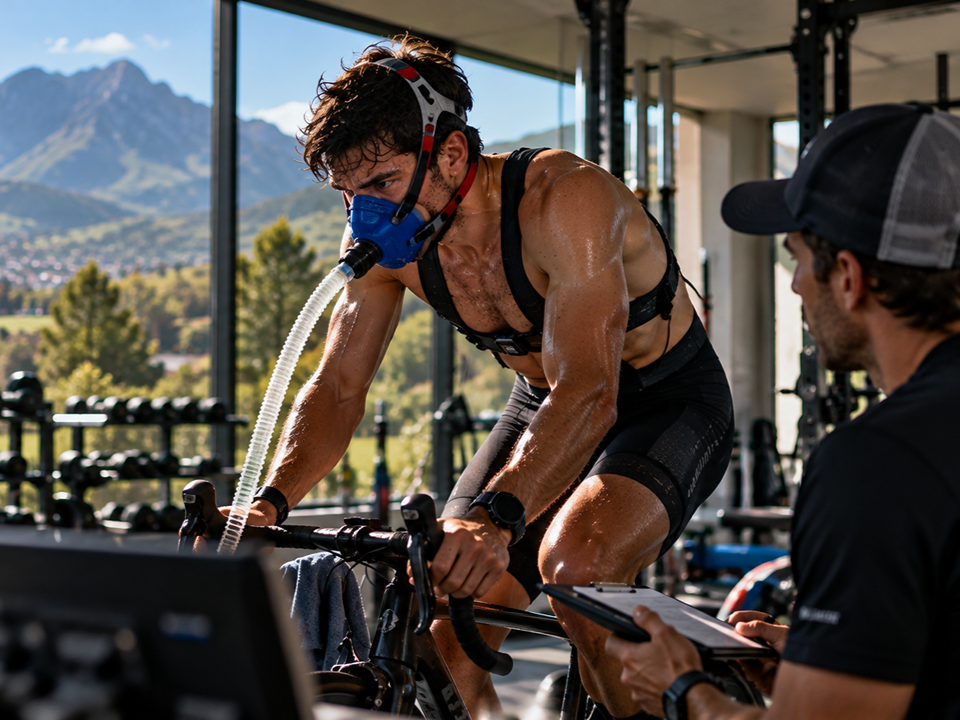
Endurance athletes often want a simple answer from testing: one number that tells them whether they are fitter, stronger or ready to perform.
The problem is that endurance performance is not one-dimensional.
A new study published in Frontiers in Physiology examined six commonly used endurance tests and found that they captured both shared and distinct aspects of physical performance. The practical message for athletes is straightforward: different tests can tell you different things, so the best test is the one that answers a useful coaching question.
One test cannot describe the whole athlete
Running tests tended to correlate strongly with one another, as did the rowing tests used in the study. But the different modalities also captured distinct information.
That matters because an athlete’s performance profile contains more than aerobic endurance. Strength, power, agility, movement economy and the ability to express endurance in a particular sporting movement can all contribute to performance.
A single test may therefore be highly useful without being a complete description of the athlete.
The mistake is not using a particular test. The mistake is asking it to answer a question it was never designed to answer.
Start with the coaching question
Before choosing a test, define what you need to know.
Is the question whether aerobic capacity has improved? Whether sustainable cycling power has increased? Whether an athlete can tolerate a particular training load? Whether strength is limiting performance? Whether the athlete is returning to consistent training after a disruption?
Different questions require different measurements.
Testing becomes much more useful when the result changes what the coach does next.
More testing is not automatically better
The study also explored whether a smaller battery could preserve much of the information contained in a larger testing programme. A reduced four-test battery reconstructed a substantial proportion of the information from the full battery while reducing testing demands.
For athletes, this is a useful reminder that testing should be efficient as well as informative.
A large testing battery creates its own costs: time, fatigue, logistics and the possibility of collecting numbers that never influence training.
The goal should not be to measure everything.
The goal should be to measure enough of the right things.
Context changes the meaning of a result
A test score should also be interpreted against the athlete’s history.
A higher power output is useful information, but what caused the change? Was the athlete rested? Has body mass changed? Was the protocol identical? Has training volume increased? Is the athlete showing better durability even if maximal performance has barely moved?
Longitudinal context often tells a more useful story than an isolated result.
This is especially important in endurance coaching, where athletes can improve in different dimensions at different rates.
Testing should support decisions
Imagine an athlete whose cycling threshold has improved but whose ability to produce repeated efforts late in a long ride has not.
A single threshold number could suggest that training is working well. A broader performance profile might reveal that the athlete’s next limitation is durability rather than basic aerobic capacity.
The response would therefore be different.
This is where testing earns its place in coaching: not because the number is interesting, but because it helps identify the next problem to solve.
The MCC coaching perspective
Performance testing should be treated as a tool for decision-making, not a collection exercise.
Choose tests because they answer defined questions. Repeat them consistently when longitudinal comparison matters. Interpret the result alongside training load, recent performance, recovery and the athlete’s event demands.
The latest research reinforces an important MCC principle: endurance performance is multidimensional, and a useful testing strategy should reflect that.
Athlete takeaway: don’t ask, “What is my fitness number?” Ask, “What do we need to know about my performance, and which measurement will help us make a better training decision?”
Source:
Kellner P, Mašek M, Neubauer J, Polách M, Punčochář M, Zháněl J. 2026. Endurance tests capture complementary dimensions of physical performance. Frontiers in Physiology 17:1973746. DOI: 10.3389/fphys.2026.1973746. Published 1 October 2026. https://www.frontiersin.org/journals/physiology/articles/10.3389/fphys.2026.1973746/full